




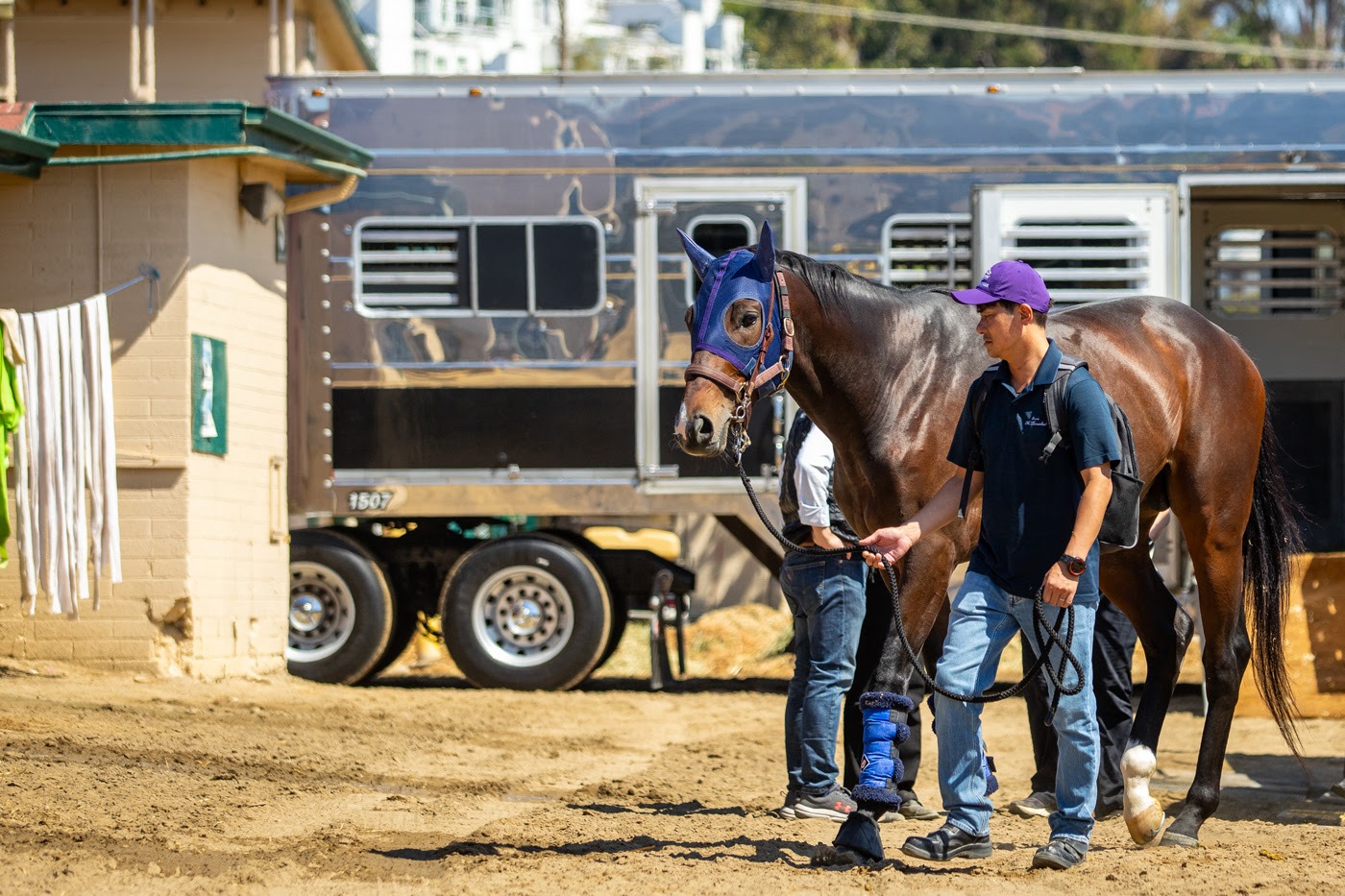
Moving a racehorse across the country is no ordinary journey. Behind every travelling Thoroughbred is a carefully coordinated operation involving specialist transport, experienced professionals and meticulous planning. As Del Mar prepares for its prestigious Turf Festival, the logistics of bringing horses from different parts of the United States once again highlight an essential, but often overlooked, part of modern horse racing: horse shipping.
The Turf Festival, one of the biggest racing weekends at Del Mar outside Pacific Classic Day, features nine races, eight on turf and one on dirt, with eight graded stakes contests. The meeting regularly attracts horses from leading stables across the country. Trainers such as Chad Brown, Brad Cox, Graham Motion and Todd Pletcher have all participated in the festival over the years, with several expected to return.
However, getting their horses to the seaside racecourse requires considerably more than arranging a flight. Horses travelling from Kentucky, New York and other destinations east of the Mississippi must be transported safely, often over thousands of miles. The process involves ground transportation, flight arrangements and specialist care throughout the journey.
Although horse shipping has become a routine part of the modern racing industry, relatively little is known about the work involved in moving a Thoroughbred weighing up to 1,200 pounds into an aircraft and transporting it across the country.
KC Casebeer, a sales manager and West Coast agent for a specialist equine transportation agency, offered an insight into the operation and the people responsible for making these journeys possible.
Casebeer has been around horses for most of her life and joined the transportation business nearly five years ago. Based in California, she initially had greater experience with show horses than racehorses, but quickly adapted to the demands of the racing industry.
Her responsibilities involve coordinating flights and managing the arrangements required to move horses from their stables to their final destinations.
“We organise the flights for the horses,” Casebeer explained. “We take care of all the behind-the-scenes stuff. We’ll get a call from a trainer or owner who has a race or a competition coming up and we put the puzzle together. We make sure we find a flight that meets their needs.”
That puzzle begins with identifying a suitable departure date and securing the necessary aircraft space. It also includes arranging a horse trailer to take the animal to the airport, coordinating the flight and organising another vehicle to collect the horse upon arrival.
Every stage must be carefully communicated between the people involved at both ends of the journey.
Casebeer explained that the arrangements cover the complete journey from the stable to the destination airport and onward ground transportation to the racecourse. The only responsibility left to the trainer or racecourse is ensuring someone is available to receive the horse.
Horse Shipping Requires Careful Planning and Specialist Handling
Flight availability is another important consideration. Horses travelling to and from California generally have access to scheduled services once or twice a week, meaning trainers must plan their movements around available departures.
The first questions usually concern the preferred shipping date and the physical size of the horse.
According to Casebeer, the dimensions of each animal determine the amount of space required inside the aircraft. Some horses can travel in a single stall, while larger animals may need additional room. These requirements also influence how the available space is allocated among different customers.
Despite the challenges associated with transporting large and sometimes unpredictable animals, horses generally adapt remarkably well to air travel.
One might expect a Thoroughbred accustomed to the freedom of a stable and training track to become uncomfortable inside an enclosed aircraft. However, Casebeer suggested that food and familiar surroundings can make a considerable difference.
“Shockingly enough, as long as they have a full hay net in front of them, they can really care less,” she said. “A lot of these horses are frequent flyers. They fly more than humans do.”
The experience of travelling is therefore not necessarily as stressful for horses as many people might imagine.
Medication is also generally avoided when horses are being transported close to a scheduled race. Trainers must ensure that no prohibited substances remain in an animal’s system when pre-race or post-race testing takes place.
From Railway Carriages to Modern Aircraft
The transportation of racehorses has a long history, dating back centuries before modern aviation made long-distance journeys considerably easier.
In earlier times, horses were moved by sea and railway. During the height of Seabiscuit’s popularity in the late 1930s, air transportation was not available for racehorses, leaving the railway as the principal option for journeys across the United States.
Seabiscuit’s owner, Charles Howard, famously arranged a customised luxury railway carriage for the champion, allowing the horse to travel comfortably between racing destinations on the East and West Coasts.
The horse covered more than 50,000 miles by rail during his career. His journeys frequently attracted public attention, with crowds gathering at railway stations and along the tracks whenever the famous Thoroughbred passed through their towns.
His return to Maryland for the celebrated match race against War Admiral was among the memorable journeys of that era.
Air transportation eventually transformed the industry. The first horses are believed to have travelled by aircraft around 25 years after the Wright brothers’ historic flight at Kitty Hawk in 1903.
One of the earliest recorded examples involved Wirt G. Bowman, a prized Thoroughbred owned by Baron Long, who was associated with the development of Agua Caliente Racetrack.
In 1928, Bowman was flown approximately 500 miles from San Diego to Tanforan Racetrack in San Bruno, near San Francisco. The racecourse had its own landing strip, allowing the aircraft to taxi close to the property before the horse was taken to the stable area.
The flight appeared to have caused little disruption. After arriving, Bowman reportedly completed a three-furlong exercise.
Another important milestone came on May 29, 1946, when Chakoora and Uleta became the first racehorses to make a transcontinental flight from New York to Hollywood Park.
Six months later, six Irish horses were transported from Ireland to California aboard an American DC-4 aircraft, marking the first transatlantic shipment of racehorses.
These developments helped establish air travel as an increasingly important part of international racing.
Safety Remains the Priority During Every Journey
Despite advances in aircraft and transportation facilities, the fundamental objective remains unchanged: ensuring that horses arrive safely and comfortably.
Casebeer emphasised that the entire process, from departure to arrival, must be organised with the horse’s welfare as the priority.
The cost of transporting a Thoroughbred by air can easily reach several thousand dollars. Fuel prices, the size of the horse, the type of accommodation required and additional equipment all influence the final expense.
Professional care is another essential component. Each flight carries two experienced grooms responsible for looking after the horses during the journey.
Ground transportation also adds to the overall cost. In California, Los Angeles International Airport and Ontario International Airport are among the facilities used for horse movements to Del Mar and other racecourses.
Although neither airport is immediately adjacent to Del Mar, flying across the country can reduce the journey to approximately a day, compared with the three or four days that might be required by road.
Specialist horse transport operators then complete the final leg, taking the animals from the airport to their respective racecourses. Trainers often have preferred transport providers, and arrangements are made accordingly.
International movements involve additional coordination, with specialist agencies handling overseas shipments and working alongside domestic transportation operators.
Demand for Horse Shipping Continues to Grow
The business of moving horses has expanded beyond the traditional racing sector. While racehorses remain an important part of the industry, show horses have become an increasingly significant part of the transportation market.
Casebeer noted that the demand for flights has grown considerably in recent years, reflecting the wider use of air travel for equestrian competitions and events.
The service can even accommodate some unexpected travelling companions. Horses sometimes share their stalls with goats, which provide companionship during transportation. These animals can also be included in the arrangements.
From Seabiscuit’s celebrated railway journeys to modern aircraft carrying Thoroughbreds across continents, the transportation of horses has evolved considerably. Yet the objective has remained consistent: getting valuable equine athletes safely from one destination to another.
For trainers preparing horses for major meetings such as the Del Mar Turf Festival, the journey begins long before the gates open. Behind every arrival is a network of professionals whose work ensures that the horses reach the racecourse ready for the next challenge.
For more stories, results, and updates from the world of horse racing, stay tuned to Racebuzz.